

- VICTORIAN TERRACE CONVERSION, DALSTON
- VINE HOUSE
- VILLAGE UNDERGROUND ROOF TERRACE
- WALTHAMSTOW CENTRAL
- REGENCY LAWN, KENTISH TOWN
- SUNFLOWER SOUNDSYSTEM
- MOONSCREEN, WAKING LIFE FESTIVAL
- MIDSUMMER MOURAMA, WAKING LIFE FESTIVAL
- CAMPARI CONCERT PAVILION, MILAN
- BENCH FOR THE ROYAL ACADEMY, LONDON
- KALA FESTIVAL STAGES
- BAMBOO DINING TABLE
- PERIOD EXTENSION, GUILDFORD
- MOUNT PLEASANT - TIMBER, STONE & LIMECRETE
- PULSE INSTALLATION, HOUGHTON FESTIVAL
- MUSLIM ACADEMY
- FEATURE STAIR AND BALUSTRADE
- BELSIZE PARK
- PHILBEACH GARDENS
- CLERKENWELL HISTORIC HOUSES
- BESPOKE STEEL TERRACE
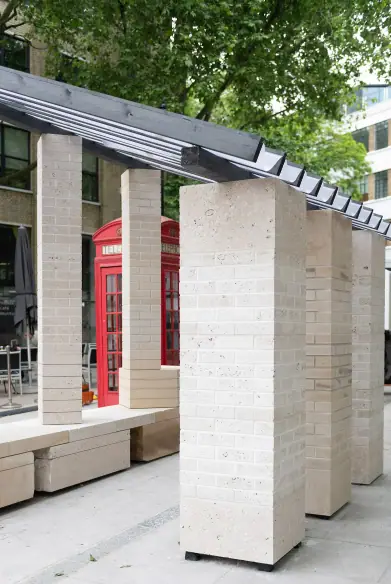
- STONE PAVILION
Design for a stone pavilion for Clerkenwell, with Artefact Architects. The pavilion design explores the use of stone as structure, and specifically stone bricks made from the large amounts of waste produced by quarries.
Stone in its raw form has the potential to be a low carbon alternative to fired masonry bricks and concrete. Its compressive strength is significantly higher than concrete. Concrete is stone that has been extracted, crushed, heated to 1450C, mixed with sand and water, to create a structural material with a lower compressive strength than the original stone! Clay bricks too, are excavated and then fired at high temperatures before they can be used. Of course concrete can be transported as a wet material, cast into different shapes, and can be reinforced to span between supports.
But used in the right way, stone has great potential as a low carbon alternative. It can also be prestressed and so used to span. Used as a vertical, load-bearing structure, it can easily perform as well as steel, concrete or brick alternatives, with a far reduced carbon intensity.
This pavilion explored the use of stone bricks. Stone is predominantly specified for surfaces and finishes. As a consequence, huge amounts of stone waste are building up in quarries.
By processing this into regular masonry brick sizes, this product can compete with the traditional clay brick. The bricks are derived from waste products, so are price competitive. And since they have the same size as clay bricks, they can be substituted for any element where regular masonry bricks are specified.
Public House are already developing a number of projects using large pieces of stone for columns, foundations and lintels. We are also substituting clay brick footings with stone bricks and sometimes large pieces of stone.
- HEMINGFORD ROAD
- BIRD MONITORING HIDE